
Can stolen crypto be frozen? When a freeze works, and when it does not
Published: Last reviewed: How we edit
Sometimes. Freezing is only possible where there is a control point: an exchange account, or a stablecoin like USDT or USDC whose issuer can block an address. Bitcoin or Ether held in a self-custody wallet stays beyond anyone but the holder. Stolen funds often move again within hours, so a prompt, well-documented report matters. It can improve the odds, though no outcome is ever certain.
Not sure what to do next? Write to us:
A freeze needs someone with the power to say no
Crypto networks have no central desk where a payment can be undone. A freeze happens only when a company holding the funds, or controlling the token, decides to block them.
So the real question is not whether crypto can be frozen at all. It is where the stolen funds sit right now, and whether the company at that spot is both able and willing to act.
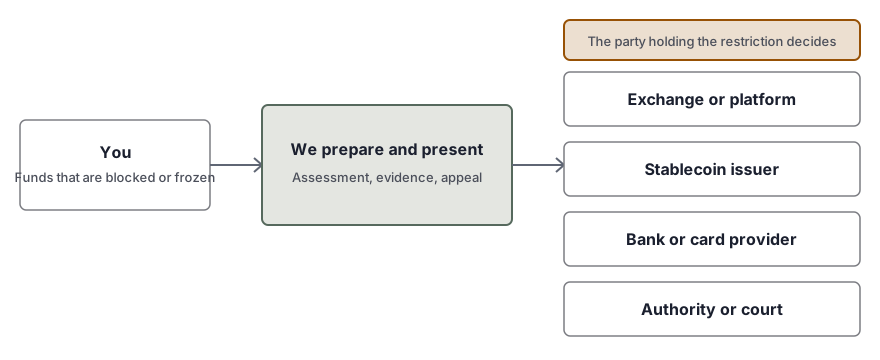
Where a freeze can realistically happen
Two main situations make a freeze genuinely possible. In both, someone besides the thief holds a lever to pull.
- An exchange account: if the thief puts the funds on a regulated exchange, that exchange can restrict the account while it reviews a credible report.
- Some stablecoin issuers can blacklist an address, which means the tokens sitting there can no longer move.
- A payment service or broker the thief uses to cash out, provided it gets a report in time and has a compliance team that actually reads it.
- The last account in the chain is a bank account, where the bank can hold back or pull back a payment using its own rules.
When a freeze cannot happen
Coins like Bitcoin and Ether that sit in a wallet the thief owns cannot be frozen. Nobody, not an exchange, not an issuer, not a court, can reach in and block a private key held on another person's device.
While the funds stay in that kind of wallet, the only realistic path is to follow them until they reach a service with a control point. That may take days or weeks, and it might never happen at all.
Money that goes through mixers, cross-chain bridges or a long line of fresh wallets is harder to trace. Hard does not mean impossible, but expect gaps along the way.
Why acting early matters
A thief planning to cash out usually moves the funds several times within a short window. Every hop stretches the trail, and the people who could step in get further away.
Timing matters a great deal here. When a report lands while the funds still sit in an account, the odds are much better than if it comes after they have moved on. To act at all, the exchange needs clear details: transaction hashes, the addresses involved, when it happened, and a short factual account of what took place.
Here is the part we cannot change: even a quick report is a request, not an order. It is up to the exchange or issuer whether to act, and plenty of them will freeze nothing unless there is a police report or a legal order.
What to do in the first hours
Keep the steps plain and your records tidy. Do not chase the thief on your own, and do not pay anyone offering a quick reversal.
- For every transfer that went out of your wallet, note the transaction hash, wallet address, amount, and the time it happened.
- Before those messages and profiles vanish, grab screenshots of everything: the websites, the profiles, the messages themselves.
- File a police report and report it to the platform you used, then hold on to the reference numbers.
- If you still control any remaining funds, move them to a new wallet set up on a clean device.
- Never give your seed phrase, private key or password to anyone, including anyone reaching out with an offer of recovery.
What to expect, and one small next step
Outcomes vary: some cases end in a partial freeze, some end with no freeze at all, and months can pass either way. And a freeze alone is not the same as recovery. Locked funds usually stay that way until an exchange, an issuer or a court decides their fate.
Here is how we can help, for free: we review your case, trace where the funds moved, and put together a plain evidence pack with drafted reports. Independent specialists do the technical work alongside us. What we cannot do is make any exchange or issuer act, and no outcome is promised.
Questions people ask
Can Bitcoin that was stolen be frozen?
Short answer: no, not while the coins rest in a wallet the thief controls. Bitcoin has no issuer, so there is no central switch to flip. Freezing becomes possible only once the funds reach a service that holds them, such as an exchange, and that service agrees to restrict the account.
If someone steals Tether or USDC, can the funds be frozen afterwards?
It can be possible to freeze stolen crypto. Stablecoin issuers have the ability to block addresses. Whether they act depends on their policies, the proof you provide, and usually a legal or police request. It is never done automatically.
How quickly should a theft be reported?
The sooner, the better. Thieves tend to shift stolen funds within hours, so speed matters more than polish. A short, factual report sent the same day, with the transaction hashes included, helps more than a detailed one that only arrives a week later. So for now, keep it plain and send it early.
If the funds are frozen, will they be returned to you?
Not automatically. A freeze only stops the funds from moving. Getting them released to you usually requires proof of ownership, often a legal order too, and the process can take a long time.
Does filing a police report actually help?
Often it does. Many exchanges and issuers move quicker when a report carries a law enforcement reference number, and a few will not take any step without one. Write the number down and give it to them when you reach out.
How we can help
- Tracing stolen crypto and requesting freezes. Follow stolen crypto, ask exchanges and issuers to freeze it, and file a police report.
- Reading a blockchain analytics report. A traced source-of-funds report, written for a compliance team to use.
- Appealing a stablecoin freeze. Build a documented appeal for Tether, Circle or another stablecoin issuer.
- When authorities freeze your crypto. Your crypto is held by authorities. We connect you with independent lawyers. We cannot give legal advice.
This page gives general information only. It is not legal advice.