
USDT address frozen: what a Tether freeze means and your possible next steps
Published: Last reviewed: How we edit
It is upsetting when your USDT address is frozen. These tokens may still show on the ledger but cannot be moved. The freeze applies to the token itself, not your wallet. Usually, this is due to a request from law enforcement or a compliance check. The entity that froze it, or a court, must remove the freeze. Trying new wallets will not help.
Not sure what to do next? Write to us:
The Truth About a Frozen USDT Address
USDT is a token issued by a company, and they designed its contract to stop certain addresses from sending or receiving funds. When that switch flips on your address, your balance stays visible on the block explorer. The problem is, the tokens physically cannot leave.
This differs from your personal exchange having an account hold. An exchange controls its own platform. A token freeze is tied to the address itself, following it wherever you try to move. This applies to any new app or device.
How to Verify That a Freeze Is Real
It is likely you are worried about a failed transfer. Remember, transfers can fail due to low network fees, sending to the wrong network, or technical errors. Please check the facts before assuming you have a major issue.
Open the public block explorer for the network you use and enter your address. Restricted addresses often carry a label or flag there, and a reverted transaction usually shows a reason code. Screenshot what you see, with the date and time visible.
- Check that the token sits on the network you expect, for example the one it arrived on.
- Check that the wallet holds some of the network's native coin to cover the fee.
- Open the explorer, find your address and the last failed transaction, and save both pages.
- Try a very small USDT transfer only when you are certain the fee is not the problem. Avoid repeating large attempts.
- Write down each transaction from the past months that touched the address, noting the counterparty and the purpose.
Why addresses get frozen
For most cases, the exact reason is not made public. Two patterns come up most often: a request from law enforcement, or a compliance flag raised by the issuer or its analytics tools.
A request from authorities is often about an investigation into someone else, such as a scam or theft. Funds may have moved between your address and an address tied to that case. A compliance flag follows a similar logic but begins with screening instead of a court or police request. Neither pattern accuses you of anything.
Who has the power to unfreeze it, and who does not
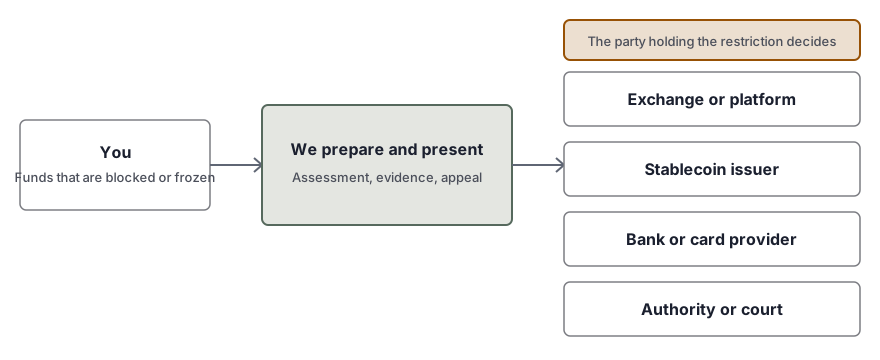
Only whoever controls the funds can lift the freeze. In practice, that means the issuer, either on its own review or because the requesting authority told it to, or a court that orders the release.
Exchanges, wallet providers, and support desks do not have the power to lift this freeze. We are also unable to remove it. Be very cautious of anyone who offers to unfreeze your address for a fee. They must go through the proper issuer or required authority. Otherwise, they are likely mistaken or are trying to sell you a scam.
What is possible, and what is not
You can reach the issuer through its official support or legal channel, ask which kind of restriction is in place, and ask what documents they need. If you know an authority is involved, a lawyer can write to it on your behalf.
You cannot push the issuer into a decision, and trying to get around the freeze is a bad idea. Sending your remaining funds through mixers or fresh wallets can look like evasion and make any review harder.
- Keep the address itself, screenshots from the explorer, and the complete history of how the funds reached you.
- Collect proof of where the funds came from: exchange receipts, bank transfers, invoices, and signed agreements.
- Reach the issuer only through channels published on its official website, never through links someone sends you.
- Write down every message you send or receive, including dates and any reference numbers.
- Never share your seed phrase, private key or password with anyone who offers to help.
A sensible next step
Here is a small step to take first: write a one page timeline. Note when the USDT arrived, who sent it, why, and what happened to it afterward. Any issuer, authority or lawyer will ask for this document before anything else.
When a large sum is frozen, or you suspect a legal request sits behind it, bring the timeline to a licensed lawyer in the relevant jurisdiction. We review cases for free, prepare evidence, and coordinate independent lawyers and analysts. This is the part we cannot change: we cannot promise the address will be released.
Questions people ask
If my USDT address is frozen, will my balance still be visible?
Yes, the balance still shows on the blockchain and in your wallet. But the token contract now blocks any transfers from that address. This means you cannot send, swap or sell the tokens.
If my address is frozen, does that mean law enforcement is looking into me?
Not necessarily. A freeze can come from a request about someone else whose funds passed through your address, or from an automated compliance flag. See it as a reason to collect your records and get advice, not as proof of suspicion.
If I shift my USDT to a different wallet, will that lift the freeze?
No. The tokens cannot be moved, because the restriction sits on the address itself. A new wallet changes nothing there, and fresh funds received from a flagged address may raise new questions.
How long does a USDT freeze last?
We cannot state a fixed period. Some restrictions hold while an authority works through a case, others lift after a review. Ask the issuer which type applies to you, and keep your evidence ready.
Should I pay a service to help get my USDT unfrozen, and is that safe?
Stay cautious here. Only the issuer, a requesting authority, or a court can lift a freeze. No one else can do it. If someone asks for an upfront fee, promises a result, or wants your seed phrase, that is a recovery scam. Walk away.
How we can help
- Appealing a stablecoin freeze. Build a documented appeal for Tether, Circle or another stablecoin issuer.
- Unblocking a frozen crypto wallet. We prepare and present cases for frozen or flagged wallets, from USD 50,000.
- When authorities freeze your crypto. Your crypto is held by authorities. We connect you with independent lawyers. We cannot give legal advice.
- Find out who froze your crypto. Learn who is behind the freeze and which next steps are realistic.
This page gives general information only. It is not legal advice.