
Source of funds vs source of wealth: what they mean and how to show each one
Published: Last reviewed: How we edit
Source of funds asks a narrow thing: where did the money in this one transaction come from? Source of wealth asks something wider: how did you gather your assets over the years? Exchanges want the first when a single deposit gets checked, and the second when an account is large or risky. Each answer needs paperwork that fits the real origin.
Not sure what to do next? Write to us:
Two questions that sound the same
Source of funds stays narrow. It looks at the money in one transfer, for example the deposit that set off a review. The reviewer wants to trace that money from where it began to the exchange.
Source of wealth is the wider picture. It shows how everything you own came to be: years of work, a business, an inheritance or gains from investing. It gives context, so the reviewer can see whether the deposit size matches your story.
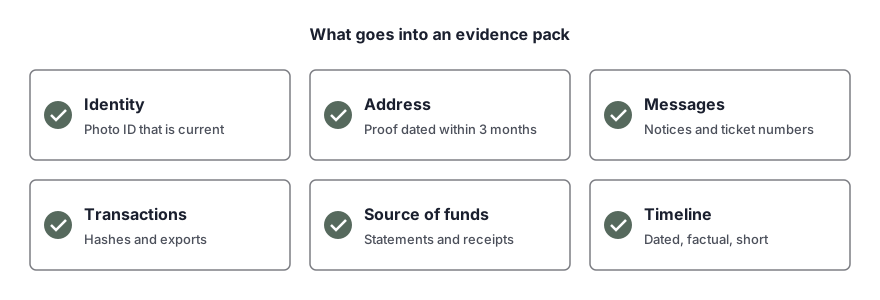
The reason platforms ask about one or the other
A source of funds request usually follows one event: a big deposit, a transfer from an address you have never used, or a counterparty that got flagged. A source of wealth request shows up when the account is large, the risk profile is high, or the activity sits far above the income you declared.
Some requests want both answers. Give each one its own section, so the reviewer can check it off without hunting through pages.
Where funds came from, and the proof that fits
Which documents work depends on where the money started. Proof of one origin may count for nothing with another. Treat the list below as a first pass, then shape it to your own situation.
- Salary: payslips, your employment contract, and bank statements showing the salary landing and the transfer out to the exchange.
- Trading profits: exports from the exchanges and statements from each platform you traded on, plus the withdrawal records that connect to this deposit.
- Mining: documentation of your mining setup, the pool payout history, and the wallet addresses that got the payouts.
- Sale of property or a vehicle: the signed sale contract, proof the buyer paid, and the bank record showing the proceeds.
- Gift: a signed letter from the giver with their details, proof of where their funds came from if asked, and the bank record of that transfer.
- Inheritance: a will or court paper, evidence of what the estate was worth, and the record of the payment made to you.
Tying the documents into one story
We understand how complex paperwork can feel. A large stack of files is often hard to process. Write three or four sentences for each path of origin. Describe what the money was, when it arrived, how it moved, and which document supports each step.
If funds moved through multiple wallets or platforms, document every hop in order. You must include the dates and amounts for each movement. Please check your narrative carefully. Mismatched numbers are the primary reason requests are denied.
Common Gaps And How To Manage Them
Life is not always perfectly straight. You might have cash savings, funds from a friend, or documents in another language. These inconsistencies are not necessarily fatal, provided you explain them honestly.
When a document is missing, offer the closest available substitute and explain the reason. Official copies or signed statements from other parties can fill this space. Do not alter or invent any paperwork. A false document will be worse than a gap.
- Ask your bank or platform for older statements first, because they often hold on to records for several years.
- Provide translations for any documents written in a language other than the one the exchange uses.
- Maintain amounts in the original currency and include the conversion date and rate.
- Explain the origin of cash using your savings history, rather than just a statement of intent.
Next Steps for Review
Start by rereading your request and noting which of the two questions it actually asks. Then create one file for each origin, plus a brief cover note that mirrors the order of those questions.
If a mixed origin feels unclear, or if an earlier answer was turned down, we can look over your documents at no cost and point out what is missing. Together we prepare the package and bring in independent specialists where needed. The final call belongs to the exchange.
Questions people ask
Do source of funds and source of wealth mean the same thing?
No. Source of funds is about where the money for one particular transaction came from. Source of wealth is about how your assets as a whole were built up. A reviewer might request one or both, and each calls for its own papers and explanation.
Is a tax return required to prove my source of wealth?
Not always, though it is strong proof of income from a job or a business. Other documents can also show wealth, for example payslips, contracts from a sale, and bank statements. Pick what matches the origin you are describing.
Can a gift serve as a source of funds?
Yes, when there is paperwork behind it. Usually that means a letter the donor has signed, their identity details, and the bank record showing the transfer. Some exchanges may also ask how the donor came by the money in the first place.
What if my funds come from earlier crypto gains?
Start by laying out the full trail: where you first bought the coins with regular money, every trade you made along the way, and the withdrawals that ended with this deposit. Exports from the platform, together with your bank statements, are what count as proof. If a piece of the chain is missing, say so and explain the gap rather than skipping over it.
How far back must I go?
The goal is to reach a clear, documented origin. This typically means going back several years. An exchange might specify the time period they require. If they do not, it is best to ask them for their expectations.
How we can help
- Packs for source of funds and wealth. We can help you compile clear documentation showing your source of funds and wealth for banks and exchanges.
- Getting an exchange account unblocked. Learn what the exchange is asking, gather KYC and AML evidence, then answer and appeal.
- Support with sanctions and AML false positives. Sanctions or AML flag by mistake: an evidence pack plus a statement filed by a lawyer.
- Find out who froze your crypto. Learn who is behind the freeze and which next steps are realistic.
This page gives general information only. It is not legal advice.