
Recovering a crypto wallet without the seed phrase: what can be done and what cannot
Published: Last reviewed: How we edit
In most cases, no. With a self-custody wallet, the seed phrase is the master secret, and the company that made the wallet holds no copy. Access may still come back if you own one more piece: a wallet still unlocked, an encrypted file plus its password, most of the seed words, or a custodial account you can verify. Without any of these, no one can restore the wallet, us included. Never share your phrase with anyone who reaches out offering help.
Not sure what to do next? Write to us:
The truth is straightforward: a missing seed phrase can't be recreated
A seed phrase, sometimes called a recovery phrase, is a set of words, most often 12 or 24, that stands for a wallet's master secret. In most modern wallets, every address and key is derived from it. The person who has those words has control of the funds.
The coins themselves never live inside the wallet app. They stay on the blockchain, and the phrase is your proof of the right to move them. A self-custody wallet maker creates that phrase on your device and stores no copy anywhere. So there is nothing to look up, and no one has the power to reset it for you.
Even a very powerful computer could never guess a full phrase, because the number of possible phrases is far too large. If a service says it can guess yours, it is not telling you the truth. So ask a different question instead: which other piece of the puzzle is still in your hands?
What you may still have on hand, and where it can lead
Take a breath, and before deciding the money is lost, write down everything still in your hands. A seed phrase is one key of several, and a few of those others unlock the same door. The table below lists familiar cases and what each can realistically lead to.
| What remains in your hands | What might follow | Who does the work |
|---|---|---|
| A wallet app or device that still opens | Depending on the wallet, you can often move the funds to a new one, or read the recovery phrase in its settings | You, working from the maker's official instructions |
| A hardware wallet with its PIN, but no written phrase | In most cases the funds can still be sent to a new wallet, and a proper backup can follow | You |
| A hardware wallet, a PIN you cannot recall, and no phrase | Your choices here are few: devices are made to block guessing, and many erase themselves after enough wrong PIN attempts | Official support from the maker, or in some cases an independent lab |
| An encrypted wallet file, though not its password | If pieces of the password come back to you, specialists can try likely versions against a copy of the file. If it is fully gone and was strong, there is no route | An independent specialist, and only working on a copy |
| Most of the words still there, but one or two are missing or hard to read | A specialist can sometimes finish the phrase by testing candidates against an address you know. Odds drop quickly with every word missing | An independent specialist works offline, under a written agreement |
| A custodial account held with an exchange or an app, where the login is lost | Recovery of the account through the provider, which usually requires you to verify your identity | The provider: we can help you get the papers ready. |
| Everything is gone: not one device, file, phrase or account left | No path. The coins stay on the blockchain, yet no one can move them. | No one |
If a wallet or device is still open
When a wallet is still unlocked on a phone, a computer or a hardware device, it can usually keep sending funds, even if the written phrase is gone. So if it opens, your first job is simple: move the funds into a new wallet, and write its phrase down and store it with care.
Plenty of software wallets can display the recovery phrase again in the security settings, once you confirm with your password or PIN. Check there first. For the exact steps, use the wallet maker's official help page, and reach it by typing the address yourself, never through an ad or a message.
After setup, most hardware wallets hide the phrase for good, yet a working PIN is still enough to sign transactions. Sign your funds out through the device itself, then set up a new backup once they are safe. If the PIN is lost, stop entering guesses: many devices wipe their data after a small number of failed tries.
Forgotten passwords, partial phrases and encrypted files
A wallet file holds its keys in encrypted form. If you have the file but lost the password, a specialist can sometimes try likely passwords against a copy of it. This can work when parts of it stick with you, like words, patterns or old habits. This is the part we cannot change: it will not work when the password was long and random and is fully gone. For today, check whether you hold the file and any fragments you remember.
A phrase missing one or two words can sometimes be pieced together by testing candidate words against an address you recognize. Each missing word makes the task much larger. It is slow, technical work done offline by people who have done it before, and it never happens on a website. We never take recovery words ourselves. If you go this route, share the words only with a specialist you have verified, and only under a written agreement.
- Work on a copy of the file. Leave the original untouched somewhere safe.
- Never type your recovery words into any website claiming to check, fix or complete them.
- Before anyone begins, put the scope and the fees in writing so you both agree on them.
- Keep the funds in your own hands. A helper who wants your coins sent first is running a scam.
Custodial accounts and vendor recovery options
With an exchange or an app that holds coins on your behalf, you likely never had a seed phrase at all. The provider keeps the keys; you keep a login. A lost login is handled through the provider's own account recovery, which usually asks you to verify your identity. Use the official process in the app or on the site, and give it time.
Some wallets work on different lines. Smart-contract wallets, shared-key wallets, and wallets using guardians or encrypted cloud backups each have their own recovery routes. Which one fits depends on how the wallet was set up. Read the maker's official help page, and look through your cloud account, email and password manager for a backup you may have forgotten.
When the wallet belonged to a person who has passed away, another path exists. This one goes through estate paperwork and the exchange's own process for customers who have died. Our page on inheritance and lost access walks through it.
Scams that target people who lost their phrase
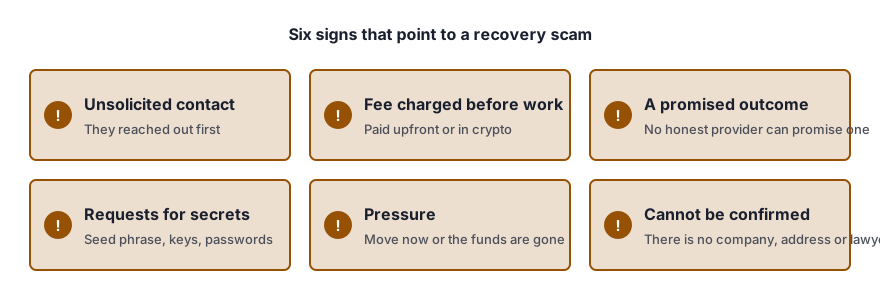
Anyone who announces publicly that a wallet is gone hears from fake helpers within hours. They answer threads, send direct messages, pay for ads and set up copies of real wallet sites. What they want is your recovery words, your password, or a fee paid in advance. If a message fits anything listed below, stop there and reply to no one.
- A stranger who reaches out to you first, saying they can recover the wallet.
- A form, an app or a so-called validation page that asks for your recovery words.
- A fee you are told to pay before anyone has even reviewed your case, or any fee sent in crypto to a personal address.
- Anyone who promises a sure result, or claims to own a special tool that can open any wallet, is not being honest with you.
- A request to put remote access software on your computer.
A sensible next step
First, write down everything you still have: devices, files, backups, account logins, old computers, notes, and rough dates for each. Then check every item against the table above. Plenty of people turn up a forgotten backup during this step.
Maybe your wallet file is there but will not open, or your hardware wallet stays locked, or you only have part of the phrase. Either way, you can ask us for a free assessment. We reply in writing about which routes, if any, look realistic. When one does, we bring in independent specialists and explain how they work, step by step. This is the part we cannot change: access that does not exist cannot be created. And no one here will ever ask you for your seed phrase, private keys or passwords.
Questions people ask
If I contact wallet support, can they restore or find my seed phrase for me?
No. With a self-custody wallet, the company that made it never saw or saved your phrase, so there is nothing for it to reset or hand back. Support can walk you through the app, but anyone messaging you with an offer to restore the phrase is running a scam.
I know my wallet addresses but I lost the phrase. Does that get me anywhere?
Addresses are public information. They let you look up a balance, but looking is not the same as controlling. Moving funds takes the keys behind those addresses. What addresses do offer: a specialist can use them to test a partial phrase or to check that a recovered wallet matches the right one.
Could a specialist work out my full seed phrase by guessing?
No. A complete phrase of 12 or 24 words has too many possible combinations for guessing to work. Specialists can only help when you already know most of the words, or when you have the wallet file and recall part of its password.
Is it safe to download a wallet recovery tool from the internet?
This is stressful, and caution is essential. Never put your recovery words into software that came from an ad or a message. We suggest using only programs found directly on the wallet maker's official website.
If I wait a while, will my coins vanish?
No. Whatever sits on the blockchain stays there while you search. It does not shrink and it does not expire. The real dangers are backups being lost as time passes, or another person finding your phrase first. Start looking for backups today, and keep anything you find somewhere safe.
How we can help
- Recovering a wallet password or file. Lost password or broken file: screened independent specialists attempt recovery.
- Assistance for Hardware Wallet Recovery. Lost PIN, damaged or missing hardware wallet: plain options and checked independent labs.
- Getting back into crypto accounts and passing them on. Lawful crypto access after death or incapacity, coordinated by our team with independent lawyers.
This page gives general information only. It is not legal advice.