
Can a wallet screening risk score be incorrect?
Published: Last reviewed: How we edit
This is complicated, but we can make it simple. The software uses data to give a rating to your crypto address. It looks at links to other addresses and services. Low, medium, and high ratings often look like green, amber, and red. These colors show how close the address is to things like mixers or scams. Remember, this score is only an estimate and may be incorrect or old.
Not sure what to do next? Write to us:
How Wallet Screening Works
We check crypto addresses when exchanges or banks require it. The software examines incoming and outgoing funds. It also reviews what other services the address has touched.
This gives a final score or a label to the address. Companies use this information to decide on deposits or withdrawals. Sometimes they will ask you for more specific details.
Understanding the Colors and Categories
Please know that no system uses a single standard scale. Different providers assign their own numbers and names. However, the core logic generally remains the same across most tools.
- Green, or low: nothing close to a risky category turned up, or anything found sits far away in the chain.
- Amber, or medium: a few connections to categories worth a second look, like gambling, some exchanges or higher-risk regions.
- Red, or high: something close or direct, such as sanctioned entities, scams, ransomware, darknet markets or mixers.
- What the labels mean: the tool can point to the kind of exposure, say a mixer, fraud or sanctions link, and can show how many steps separate you from it.
- Direct versus indirect exposure: a direct link generally counts for more than one that is several hops away.
How a score can go wrong
These tools run on patterns and probabilities, so mistakes are possible. Indirect exposure is the usual trouble. Money reached your address from someone who had received it from a flagged source, and the score picks up that far-off link even though you had no way to see it.
Clustering is another issue. Software lumps together addresses it thinks share one owner, and now and then it lumps them the wrong way. Labels can go stale too, since a service may change hands or an address may be used again after the original risk was gone.
The same address can also get different answers from different providers. One tool shows a high score and another a low one. That gap is a fair reason to request a closer review.
When a score leads to a block
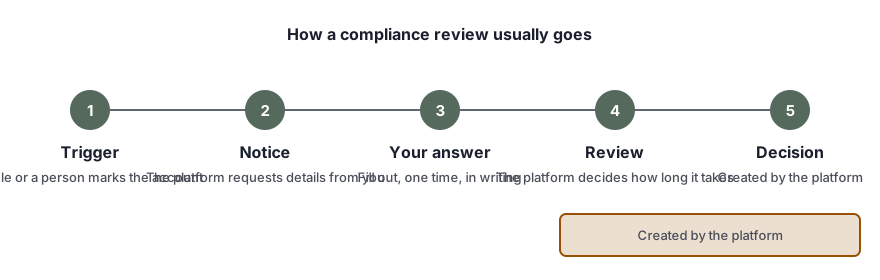
If a company sees a high score, it may hold your deposit or limit the account while it looks into things. It could ask where the funds came from, for identity documents, or for a note explaining the transaction.
Usually the company will not point to the score itself. Instead you may just hear that the account is under review. So it is worth asking directly which transaction or address triggered the alert.
Contesting a score, step by step
A challenge works well when it is precise. Give the exact address and transaction, then add a brief written explanation supported by your documents.
- Ask the company to tell you which address and which transaction set off the alert.
- Put together a transaction history that shows how the money reached you and what it was used for.
- Include evidence of where the funds originally came from, for example exchange records, receipts or a bank statement.
- Ask the company to look at the alert again, or to rerun the check with its provider.
- Note down each reply you receive in writing, and use only the official channel for everything.
Where we can help
You can have your case assessed at no cost. Independent specialists go through the address history, explain what the score probably reflects and help you prepare a clear challenge. Here is the part we cannot change: we cannot alter a score or make a company accept a challenge. And we will never ask for your seed phrase, private keys or passwords.
Questions people ask
Does receiving a red score mean that my crypto wallet is criminally involved?
No. This score simply means the software detected a possible connection to a higher risk category. That link could be old or indirect. A human reviewer examines this information. Providing clear documents often helps settle the matter.
Can I check the screening score for my own wallet?
You can find some free limited checks from analytics firms. Others sell full reports only to businesses. Since results vary between these different tools, you should treat any single score as just a hint, not the final word.
Is it possible for a wallet screening score to be removed?
Providers can change a label if they get strong evidence, but they are not obligated to do so. For now, the practical aim is to give the company holding your funds confidence, rather than attempting to change the score itself.
Why might an exchange accept a deposit but then decide to freeze it later?
New information means screening might run again. A label can update even after the deposit happens, which starts a review of funds already accepted. Next, the exchange might ask you for documentation.
How we can help
- Disputing wallet risk flags and screening results. Flagged as high risk by a screening tool: trace the funds and dispute the label.
- Reading a blockchain analytics report. A traced source-of-funds report, written for a compliance team to use.
- Packs for source of funds and wealth. We can help you compile clear documentation showing your source of funds and wealth for banks and exchanges.
- Find out who froze your crypto. Learn who is behind the freeze and which next steps are realistic.
This page gives general information only. It is not legal advice.