
Sharing documents with a crypto recovery service: what to send and what to keep private
Published: Last reviewed: How we edit
Take this one small step at a time. For our first assessment, a plain written account is enough. We only need public details like wallet addresses, dates, and transaction hashes to begin. Next, you can send identity documents only after we have checked who we are dealing with and agreed upon a written scope. Please never share a seed phrase, a private key, a password, or remote access to your device, whoever might ask for it.
Not sure what to do next? Write to us:
Share a little at a time
When your crypto is gone, a lot of people will ask to see your papers: exchanges, banks, police, lawyers, and recovery services. Scammers understand that pattern. A few fake services exist for one reason only: to gather your identity papers, your wallet access, or both.
A legitimate provider will want the facts of what happened. It will never want the secrets that unlock your wallet. If you share things step by step, checking each party first, a real provider gets what it needs while a fake one gets almost nothing.
| Stage | What you can safely share | Condition |
|---|---|---|
| 1. First assessment | A brief written summary: which platforms, when, how much, plus transaction hashes and public wallet addresses | We will first check if the entity exists. You do not need to send personal identification right now. |
| 2. After you agree on a written scope | Redacted statements, chat exports, screenshots, notices, police report number | This is the part where you confirm the party, review our fee model, and see who will access the files. |
| 3. When a filing is necessary | Your ID and address papers, records showing the funds are yours, and forms you sign | This is stressful, and we can handle this together. First, identify the recipient and the stated purpose. Give identity documents directly to the needed authority whenever possible. |
| Never, at any point | Your recovery seed, secret keys, login passwords, single-use codes, and remote control tools | No reason makes it safe. Any request for them is a warning sign. |
What you must never share
These are the keys to everything, not proof of anything. Anyone who gets hold of them can empty your funds or seize your accounts. No honest review, trace, or filing will ever require them, so if someone asks, treat that as a red flag.
- We don't need your seed phrase or a photo of it.
- Secret recovery information: private keys themselves, exported key files, and the keys stored within a wallet app.
- All secret codes and login info for your phone, banking, email, crypto wallets, and trading exchanges.
- One-time codes, authenticator codes and backup codes.
- Letting someone into your computer or phone from a distance, such as during a screen-sharing session.
- Keep API keys used for trading or withdrawing, and the complete card number plus its security code.
- Take a photo or scan of the documents listed above. Check every image for any code or phrase appearing in a corner of the screen.
Remove private details first
This is stressful, so let us manage this carefully. Redaction simply means hiding any details not needed for the next stage. This protects you if a file were ever leaked. You must hide details the right way. A black box over text in an editable PDF often leaves the hidden text accessible, which allows anyone to copy it.
First, use a tool designed to remove the text completely, or print the page into a new PDF. Alternatively, take a picture of the redacted result to send. Also remove any hidden file metadata. Pictures and documents sometimes hold data like device names, dates, and locations.
- For now, hide full card numbers, ID numbers we do not specifically request, any transactions not related to the case, and names of people not involved.
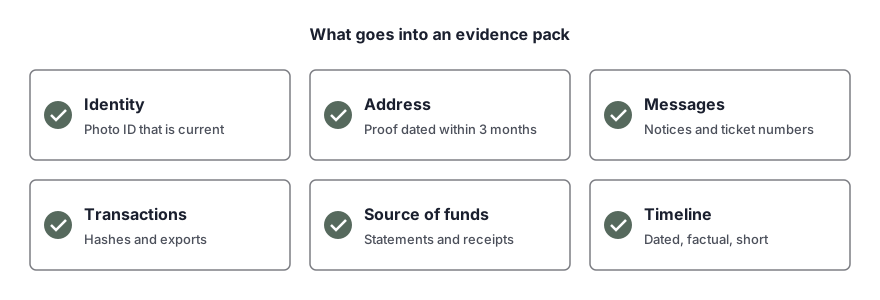
- Next, keep your name, essential account or wallet identifiers, the relevant dates, the amounts, and the specific lines that prove what you are claiming.
- Label every copy as redacted and always keep your original, unredacted file safe. Do not change any date or number found in the records.
- To prevent misuse, add a visible note to identity copies. Include details like the recipient's name and today's date.
- When a court, police unit, or platform requires unredacted files, provide them directly to that official body.
Pick a safe channel for your files
Send files through the channel the other party names, and only if that name came from a source you trust, like their website typed in by you, not a link from a message. Skip social media chats, public group chats and open share links.
- The safest route is a portal on a website you typed in yourself, or messaging or email that is encrypted end to end.
- Sharing a folder link? Set an expiry and a password, and switch off public access.
- Put a strong password on the archive, then send that password separately, for example by a call you place yourself.
- Do not send from a device that might be infected, and stay off public Wi-Fi while sending.
- Write down every item you share: the date, the recipient and the method used.
- First, ask in writing how long your files will be kept. Also ask how they delete them once your case is over.
Check who you are dealing with
Look into the party before you share anything past stage one. A genuine firm expects your checks and replies in writing. Our guide on spotting recovery scams has a longer checklist, and it applies to us too.
- Check if the company's full legal name and registration number match the official government records.
- Determine who will view your documents: staff, lawyers, or specialists. Always ask for specific names and their roles.
- Look up the lawyer in the state or bar register. Verify their license yourself; do not trust links they provide.
- See how they reached out to you. Contacting you without you initiating contact is often a warning sign after a loss.
- Ask if they request payment, login details, or private information before explaining their intended work.
A sound confidentiality pledge, described
It is worrying to hear vague assurances that your data is safe. A truthful commitment is written down and specific about its bounds. It should explain what is covered, who sees it, how long it stays, and how to delete it.
We clearly name who will see your documents in writing, and you approve everything sent. Make sure any provider gives you this same written approval process.
| Item | What an honest promise looks like | What should raise a flag |
|---|---|---|
| What is included | Everything you hand over to us, in whatever form it arrives | A pledge that protects only vaguely defined 'sensitive' materials |
| Who gets access | Specific staff members and named independent partners who genuinely need it, each committed in writing | Unnamed 'trusted third parties' with no stated roles |
| Goal | Solely for reviewing and working on your case | Used for marketing, selling data, or other clients' paperwork |
| Storage and deletion | A stated retention period, plus deletion on request unless the law says the files must stay | They keep no deletion rules, or refuse to erase |
| Disclosure | Shared with authorities only where the law requires it, and you are told whenever the law allows | A promise of absolute secrecy that no one can actually keep |
| Approval | You approve what goes to each recipient | Documents forwarded without asking you first |
Already shared more than you meant to
It happens to careful people, and there are steps that help. Work through the list below in order, and keep a note of what you did and when. If you would like help sorting the evidence later, ask us for a free assessment. We confirm in writing whether we can assist, and we never ask for your secrets.
- If a seed phrase or private key got shared, the wallet has to be treated as compromised. Create a new wallet on a clean device first, then move whatever funds are left into it.
- Password or code shared: change it right away, sign out of every session, and set up a new two-factor method.
- If you let someone connect remotely, first disconnect the tool and uninstall it. Then, from a different device, run a security scan and update your passwords, one at a time.
- If your ID papers end up with someone unvetted, here is what helps: notify your bank first, look into fraud alerts or credit monitoring in your area, and keep an eye out for accounts opened with your name.
- Report what happened to the police or your national cybercrime service, and write down the reference number they give you.
Questions people ask
Do I need to send my passport for a free assessment?
In most cases, no. A short written account plus public details like transaction hashes, wallet addresses and dates is enough for a first look. Identity documents only come later, if a filing requires them, and it is safer to send those directly to the platform or authority asking for them.
Will sharing screenshots from my exchange account put me at risk?
Yes, if you look over every image before sending. Check that no one-time code, API key, recovery phrase or full card number shows, and cover details the next step does not need. Keep your original screenshots, since a reviewer may want them later.
A service wants to connect to my computer to inspect my wallet. Is that okay?
No. Giving remote access hands someone control of your device, your accounts and everything open on screen. An honest assessment, trace or filing never needs it. See the request as a scam and stop the contact.
How long can a recovery service hold onto my documents?
There is no single rule here. In some places, the law sets how long records must be kept. Ask a provider to state its retention period in writing, and to explain how your files are deleted once the case closes. If they cannot answer those two questions plainly, they are not ready to hold your data.
Could a provider promise no one else will ever see my documents?
No honest provider can promise that. To do the work, files sometimes have to go to named lawyers or specialists. And the law can require disclosure to authorities or courts. A fair promise puts those limits in writing and asks for your approval before anything is shared.
How we can help
- Preparing digital evidence for crypto cases. Gather and file your chats, screenshots and records so they are usable by police, platforms or lawyers.
- Help after a crypto scam. After a crypto scam: a steady hand to assess, record, follow the money and request freezes.
- Recovering a wallet password or file. Lost password or broken file: screened independent specialists attempt recovery.
- Tracing stolen crypto and requesting freezes. Follow stolen crypto, ask exchanges and issuers to freeze it, and file a police report.
This page gives general information only. It is not legal advice.