
After an investment, romance or fake platform scam: what can still be done
Published: Last reviewed: How we edit
Money lost to a scam of this kind (a bogus investment, a romance ruse or a fake platform) returns only in some cases, and nobody can promise it. Everything turns on where the funds went and whether an exchange or issuer is able to freeze them. We help you take a steady breath, save evidence, report the scam, have independent specialists trace the funds and send freeze requests. Reporting to the authorities is free in most places.
Not sure what to do next? Write to us:
Everyday situations
- A trading app displays a big profit yet demands more money before releasing any withdrawal
- Someone you have never met in person suggested moving savings into crypto as a team
- You moved funds from your bank into an exchange, then forwarded them to a wallet address that the other person provided
- Someone posing as support wanted a screen sharing app installed on your device
- A site imitating a real exchange received your deposit
- An AI trading bot, a signal channel or a group chat pledged steady returns
- You paid more than once, since every payment brought a fresh reason to pay again
- A fee is now being demanded by someone who says they can recover your loss
This fits if you
- An investment platform showed you gains, took your crypto, and then blocked your withdrawals
- A person you met online, through a dating app or a chat, talked you into investing or sending money
- Withdrawing your own balance supposedly required a charge, a tax or a deposit paid first
- After the loss, someone you do not know offered to get your funds back, and you are unsure about them
- You are not sure it was a scam and would like a quiet second opinion before taking any other step
How the case runs
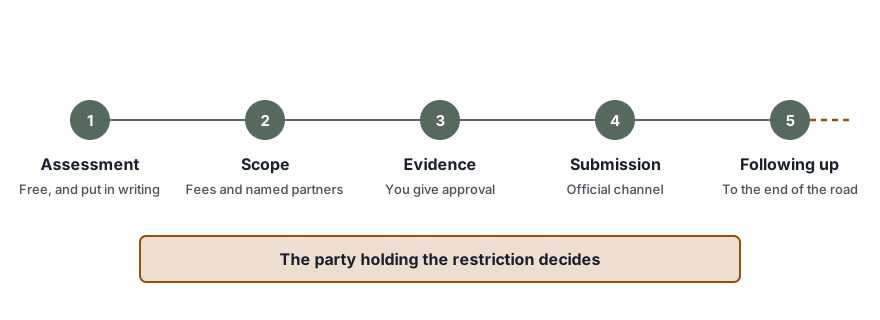
- A free first look
Share what happened and whatever you have. Our written reply gives an honest view of what is realistic. It costs nothing, creates no obligation, and you may stop whenever you like.
- Scope and fee, written down
If we can help, the scope, the independent specialists and the fee model come to you in writing. Read it at your own pace. A deadline is never used to push you into paying.
- Evidence and tracing
Send documents through a secure channel. We look them over for gaps, while the analysts trace the transfers and describe their findings in plain language.
- Reports and freeze requests
With our help you file the police report, and freeze requests go to each platform the trace identified. Copies and every reference number come back to you.
- Follow-up and wrapping up
We follow replies and answer your questions, and we say clearly once a route is exhausted. When the case closes, you receive a brief written note listing what was attempted.
What we do
- Start by listening
We begin with your account of events, as you would tell it, and with whatever you have sent or shared up to now. Shame often follows a scam, which is understandable, and it should not keep you silent. Then we divide the facts from the open questions.
- Protect what is left and secure your accounts
First, a short list of what to pause: more payments, shared access, and any app you were asked to install. Then we walk you through changing passwords and moving what remains to a new wallet yourself. Handing us access is never needed.
- Build one clear, dated file
We help you put together a timeline, transaction hashes, wallet addresses, screenshots of chats, ads and websites, and bank records for every payment. A tidy file makes it much easier for police or a platform to act on your report or request.
- Follow the money with independent analysts
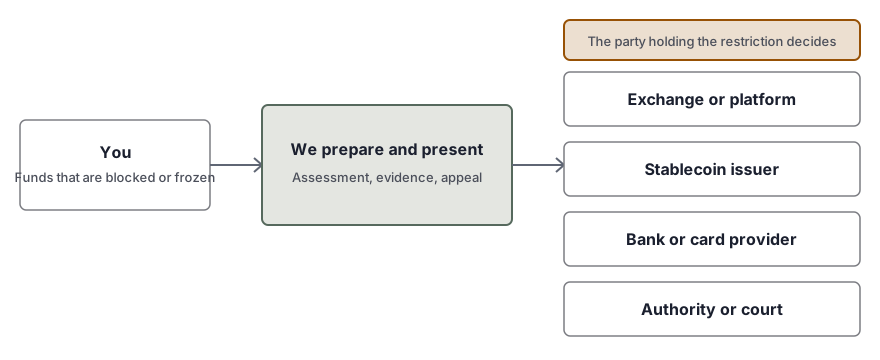
Independent blockchain analysts follow the transfers from your payment onward until they stop, perhaps at an exchange deposit address or a stablecoin address. A written summary tells you plainly where the trail ends.
- File reports and send freeze requests
When the trace arrives at a platform able to act, we help you send it a structured freeze request with the evidence. Reports to the police, and to the site where you met the scammer, are part of this too. What happens next is the recipient's decision.
- Review recovery offers and plan what comes next
Perhaps someone has already offered to get your funds back. We read that offer alongside you and name the warning signs we see. You also get an honest answer on whether to involve a lawyer, complain to a regulator or bring a civil claim, and on whether the case has run its course.
What to have ready
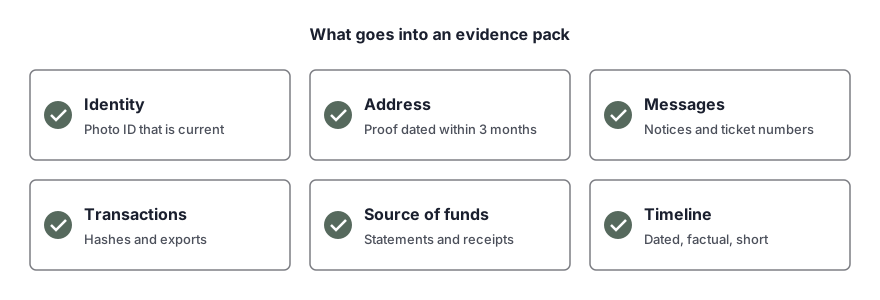
- The wallet addresses and transaction hashes behind every payment you sent
- Screenshots of the site, app, ads and profiles, plus the entire chat history with the other person
- Statements from your bank, card or exchange covering the payments that funded the transfers
- What the scammer used to reach you: names, handles, phone numbers, emails, web addresses
- Contracts, invoices, balance screenshots or fee demands that came your way
- Reports you have already filed, together with their reference numbers
- A brief timeline, in your own words, running from first contact to the final payment
What we cannot do
- This is the part we cannot change: exchanges, issuers and police forces each decide for themselves, under their own rules and the law they work under, and we cannot make them act.
- No one can promise that scammed funds will come back, and we do not either. Many cases finish with a well documented record but no money back.
- Once funds sit in a private wallet or have passed through a mixer, they usually cannot be frozen. If the trail ends there, we tell you.
- Hacking wallets, negotiating with scammers and paying anyone to release funds are things we do not do. Offers to do them are scams.
- Your seed phrase, private keys and passwords stay with you. Nor do we ever request remote access to your device.
Questions people ask
Can lost crypto be recovered after a scam?
Sometimes, though not often, and it all turns on where the funds went. A freeze request can help if they reached an exchange or stablecoin issuer that is able to act. A private wallet usually leaves nothing to freeze. No one can promise a result.
Is it free to report a scam to the police?
Usually it is. Police forces and national fraud services take a report without charging the victim. You also leave with a reference number, which banks, exchanges and lawyers frequently request. If anybody wants payment to file a report or move it along, treat that as a red flag.
Am I to blame for falling for this?
No. Scammers plan with care and tailor their approach to each person, and careful, experienced people get caught as well. The blame sits with whoever lied to you. What helps now is to work from facts: save the evidence, report it, and guard against a second loss.
A company wants a fee to recover my money. Should I pay it?
Hold off until you have checked them out. People who were scammed once are frequent targets for fake recovery offers. Red flags include a fee up front, a pledged result, talk of contacts on the inside, and any ask for access to your wallet. Request a written scope plus a registered company name, and confirm both on your own.
Why will my trading platform not let me withdraw?
A common sign of a fake platform is a site that displays a balance yet blocks withdrawals, or insists on a fee, tax or verification deposit before paying out. On such a site the figure is just text on a page, and no money is held for you. Stop paying, save everything and ask us for an assessment.
What if the scammer keeps getting in touch?
Do not pay them again, and do not threaten them. Keep every message, because each one is evidence, and only then stop replying. Asking for a refund may lead them to delete accounts or invent new fees. Then report their account to the site or app where they contacted you.
How long it takes
The early days can count for freeze requests, though it is not too late if time has gone by. Tracing may take days or weeks, and platforms and police can be slower still. After the assessment you get an estimate from us, and a new one each time something changes.
Fees
Nothing is charged for the assessment, and reporting a scam to the police costs nothing in most places. Whether we can help is settled before fees come up, and then the scope and fee model arrive in writing. Be wary of any recovery offer that wants payment first and explains the work later. Fees →
Related situations
- Tracing stolen crypto and requesting freezes. Follow stolen crypto, ask exchanges and issuers to freeze it, and file a police report.
- Reading a blockchain analytics report. A traced source-of-funds report, written for a compliance team to use.
- Preparing digital evidence for crypto cases. Gather and file your chats, screenshots and records so they are usable by police, platforms or lawyers.
- When authorities freeze your crypto. Your crypto is held by authorities. We connect you with independent lawyers. We cannot give legal advice.
Read next
Sources
These are the official or authoritative pages behind this page. Sources get updated over time, so check them for the current wording.
- Refund and Recovery Scams · U.S. Federal Trade Commission
- What To Know About Cryptocurrency and Scams · U.S. Federal Trade Commission
- Recovery room scams · Financial Conduct Authority
- Increase in Companies Falsely Claiming an Ability to Recover Funds Lost in Cryptocurrency Investment Scams · FBI Internet Crime Complaint Center (IC3)
This page gives general information only. It is not legal advice.