
Reporting a crypto scam: official channels, country by country (eight in total)
Published: Last reviewed: How we edit
To report a crypto scam, start with the police or national fraud service in your country. Do it the same day you contact your bank and the exchange. In the US, that means the FBI's IC3. In the UK, it is Report Fraud. In Canada, use the Canadian Anti-Fraud Centre. In Australia, go to Scamwatch and ReportCyber. Filing a report is usually free. Official channels can change, so check the government page first before you send anything.
Not sure what to do next? Write to us:
Getting ready to report: what to gather first
The same first steps apply everywhere, and they make your report stronger. Stop paying, even if someone promises one last fee will free your funds. Contact your bank or card provider and the exchange you used, since funds still in their hands are the ones they may be able to act on. Then collect the items below and find your country in the table.
- For every transfer, write down which wallet address got the coins, which coin it was, how much moved, and when it happened.
- The transaction hash for each transfer.
- Please share how the scammer initially connected with you. This includes apps, sites, phone numbers, and domains.
- Every exchange and bank your funds moved through.
- Screenshots of the chats, profiles, websites, and any demand for balances or fees.
- A brief timeline running from first contact through the final payment.
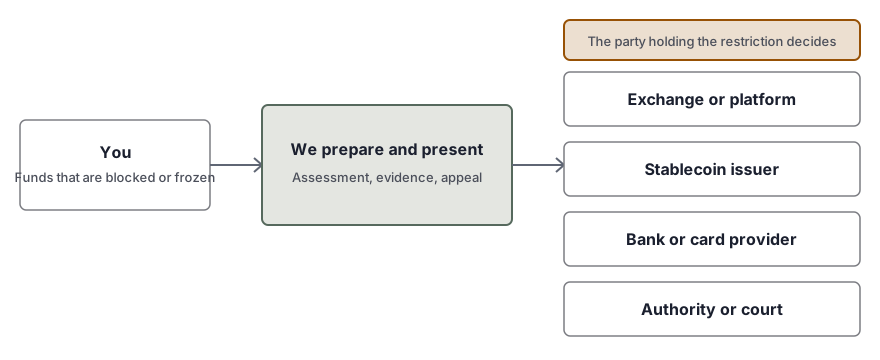
Official reporting channels in eight countries
In the table you will find, for each country, the main official channel, what to have ready, and one note worth reading. Think of it as a place to begin, not legal advice. Since channels, names and phone numbers can change, check the official page linked under sources before filing anything.
Enter the web address by hand, or get there from the country's official government site. If the person who reached out to you first sent a reporting link, do not use it.
| Country | Who receives the report | What to have ready | Notes |
|---|---|---|---|
| United States | You can file with the FBI Internet Crime Complaint Center (IC3) at ic3.gov. Fraud reports also go to the Federal Trade Commission through ReportFraud.ftc.gov. | The wallet addresses that received funds, which coin and how much, the date and time, each transaction hash, how the scammer first reached you, apps, websites, phone numbers, domains, any exchanges involved, plus screenshots. | IC3 accepts reports from inside the US and from other countries, then passes them along to field offices and agencies. File even when you lost nothing. |
| United Kingdom | Use Report Fraud, which took over from Action Fraud, at reportfraud.police.uk, or call 0300 123 2040 in England, Wales and Northern Ireland. In Scotland, contact Police Scotland on 101 or through their online form. | Transaction hashes, wallet addresses, screenshots, and a timeline of events. Hold onto your own copies of everything as well. | You will be given a police crime reference number, though the service does not run an investigation into every case on its own. Contact your bank right away. The FCA also asks that crypto investment scams be reported to it. |
| Canada | Canadian Anti-Fraud Centre (CAFC): use their online reporting system or call 1-888-495-8501. File a report with your local police and your bank too. | The evidence list above, along with the details of any payment that went through your bank. | If you suspect investment fraud, you can also contact the Canadian Investment Regulatory Organization. The CAFC notes that recovery pitches that charge a fee are another layer of the same fraud. |
| Australia | Scamwatch (National Anti-Scam Centre) takes scam reports, ReportCyber handles police reporting of cybercrime (hotline 1300 292 371), and Moneysmart (ASIC) covers investment scams. | Use the evidence list above. Reach out to your bank and the exchange first. | IDCARE provides free help at 1800 595 160. According to Scamwatch, it never asks for money or account information, and fake ReportCyber complaints are a known problem to watch for. |
| Germany | Go to any police station, or use the online police portal for your federal state (portal.onlinewache.polizei.de takes you to the state portals). You can also file a complaint with the public prosecutor or the local court. | Wallet addresses, transaction IDs and everything in the evidence list above. | It costs nothing to file a criminal complaint. For emergencies, call 110. Austria and Switzerland handle this through their own bodies, like the cantonal police and fedpol in Switzerland. |
| Spain | You can file with the online complaint office of the Policía Nacional (denuncias.policia.es) or use the Guardia Civil's electronic complaint. For advice, INCIBE runs a free and confidential helpline at 017. | Use the evidence list above. Save the reference number the online form gives you. | Once the web form is done, the local rules say you have to sign at a police station within 72 hours. That rule can change, so look it up before you go. The online path only fits cases with no known suspect, no violence, no witnesses, and no minors involved. INCIBE can guide you, but the actual complaint must be filed with the police. |
| Japan | For cyber incidents, Japan's National Police Agency runs a consultation window. It passes your report and questions to the police in your prefecture, so pick where you live. If it is an emergency, call 110. For police advice that can wait, call #9110. | Use the evidence list above, including transaction details and screenshots. | Since 29 March 2024, one online window handles these cases. To file the formal damage report, visit your closest police station. For consumer matters, call 188. |
| United Arab Emirates | In Dubai, you can report a crypto scam through the Dubai Police eCrime service. For the rest of the UAE, use the government guide on u.ae for economic crimes. Other options are the MoI UAE app and Abu Dhabi Police's Aman service. | The evidence list above, plus the names of any platforms involved. | Dubai's service might only cover that emirate, so look at the page first. Dubai Police contact centre: 901. For urgent help, call 999. |
What reporting can do, and what it leaves unchanged
When you file a report, it goes on record, and in many places you get a reference number. Exchanges, banks and lawyers will often ask you for that number. It also lets the authorities connect what happened to you with many other victims.
Filing a report will not bring your money back, and no one is obliged to look into each case. In the UK, for instance, you get a crime reference number, yet the service does not investigate individual reports itself. Save your own record of each report and each response you receive.
Once crypto has been sent, getting it back is difficult. A report does the most good while the funds still sit with an exchange, a bank, or another party able to act, and the sooner that party hears from you, the better. If today is possible, report today. Then send the reference number to your bank and to the exchange.
Can't find your country in the table?
Begin with your national police force. If your country runs a fraud or cybercrime reporting centre, use that too. Your bank can tell you which reporting channel it works with. The current channel is also listed on government and consumer-protection websites, so type their web address yourself.
If the person who scammed you, or the exchange involved, sits in another country, start by reporting it where you live. Your local police can forward the case onward, though they may have no power to act abroad themselves. For every report you file, write down the reference number and keep it.
Once you report, expect recovery offers
If you report a scam, you may be contacted later by someone offering to recover your funds for payment. Organizations like the US Federal Trade Commission, the FBI's IC3, the Canadian Anti-Fraud Centre, and INCIBE all warn about this situation. The FTC suggests you do not pay anyone who reaches out to you with an offer like this.
Real law enforcement does not charge for its work. That is IC3's plain message. Nobody should ask you for money to file a report, or to move it along faster. A seed phrase, private key or password stays with you, always. The same goes for remote access: never let anyone onto your device.
Want a hand getting your evidence ready, following where the funds went, or sending freeze requests? You can request a free assessment from us. We give you a written answer first about whether we can help, before any talk about fees. What we cannot do is make an authority or a platform take action. And we will never ask for your seed phrase, private key or password.
Questions people ask
Do I still need to report if the amount I lost was small?
Reporting is up to you, and it can still help. The FBI's IC3 asks people to file even when no money was lost. Your report becomes part of the picture authorities build across many victims, and you get a reference number, which banks and exchanges often request.
Should I go to the police or the exchange first?
Both, on the same day. Which one comes first matters less than how soon you file. The exchange can check funds it still holds, while the police can give you a reference number and may send formal requests to platforms. Write down every reference number.
Is there a fee to report a crypto scam?
Filing a report usually costs nothing. IC3 states that actual law enforcement work is provided without a fee. So if anyone asks you to pay in order to file, to move faster, or to 'unlock' a report, that is a warning sign of another scam.
If my country is missing from the table, where can I report it?
Begin with your national police, and with a national fraud or cybercrime centre if your country has one. You can also ask your bank which channel it suggests. One small step for now: type the government website address yourself, instead of following any link someone sent you.
If I report it, will I get my crypto back?
On its own, usually no. A report creates a record and may reach a platform that is able to act. Once a crypto transfer has been sent, getting it back is hard, and no authority or provider can promise an outcome. Reports still count as evidence, and they help banks and other people who might be targeted next.
How we can help
- Help after a crypto scam. After a crypto scam: a steady hand to assess, record, follow the money and request freezes.
- Tracing stolen crypto and requesting freezes. Follow stolen crypto, ask exchanges and issuers to freeze it, and file a police report.
- Preparing digital evidence for crypto cases. Gather and file your chats, screenshots and records so they are usable by police, platforms or lawyers.
- Regulator and ombudsman complaints for crypto issues. Organize a clear timeline for your complaint to a regulator, ombudsman, or consumer agency.
Sources
These are the official or authoritative pages behind this page. Sources get updated over time, so check them for the current wording.
- Crime information: Cryptocurrency · FBI Internet Crime Complaint Center (IC3)
- Cryptocurrency fraud: how to report · Report Fraud (City of London Police)
- Reporting cybercrime and fraud · Canadian Anti-Fraud Centre
- Report a scam · Scamwatch, National Anti-Scam Centre (Australia)
- Filing a criminal complaint with the police (consumer centre guide, in German) · Verbraucherzentrale
- Online complaints office (in Spanish) · Policía Nacional (Spain)
- Consultation window for cyber incidents (in Japanese) · National Police Agency (Japan)
- Reporting economic crimes · UAE Government portal (u.ae)
This page gives general information only. It is not legal advice.